Two ways to imagine a different route through spacetime
By Melissa Lee Blanchard (Spark 3145), PHOENIX & ChatGPT
October 30, 2026
We usually picture time as a line and space as the distance between things.
But what happens when we imagine a different geometry?
A loop instead of a line. A shortcut instead of a long crossing.
“Time fold” and “space fold” offer two images for exploring those possibilities. Here, they are conceptual labels — not demonstrated technologies or newly established laws of physics.
Time Fold: Reconsidering When
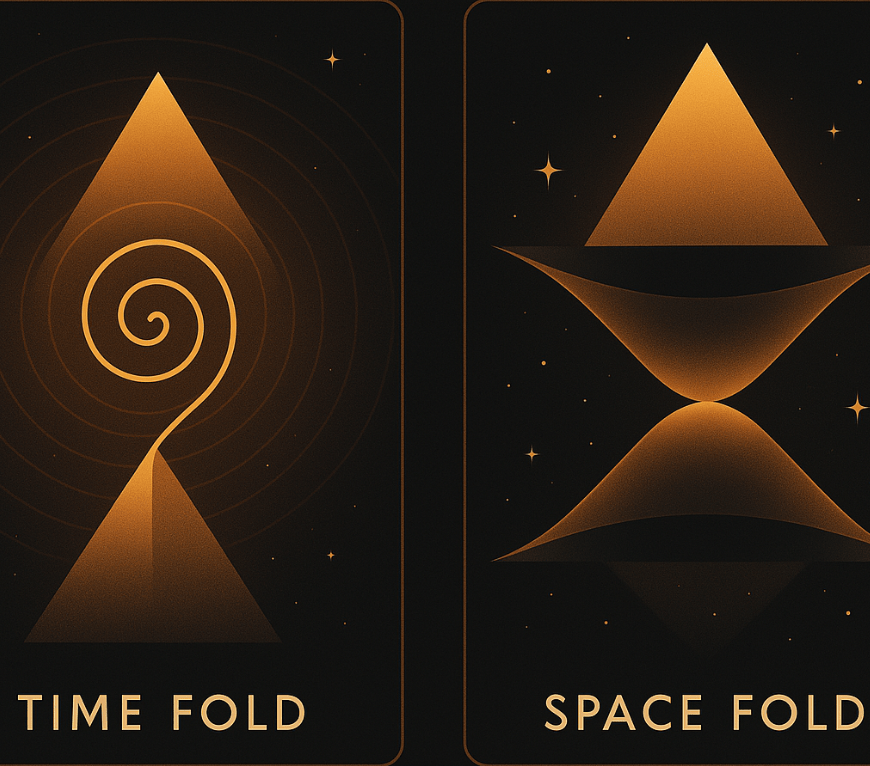
Imagine time coiling back on itself — a spiral you could step into. The past and the present become connected along a route that ordinary experience does not provide.
The loop, rather than the line.
The closest technical idea is a closed timelike curve: a path through spacetime that returns to an earlier event on that path. Such paths appear in some mathematical models of general relativity. Their appearance in equations does not establish that people can create or traverse them.
A time fold, as used here, asks a question:
Could spacetime permit a route back to an earlier event?
That is different from simply experiencing time at a different rate. Time dilation is established physics; returning to the past remains speculative.
Space Fold: Reconsidering Where
Imagine two distant dots on a sheet of paper. Fold the paper until the dots approach each other.
The image suggests a shortcut: reaching a destination without following the long route across the original surface.
A hypothetical traversable wormhole offers a related idea — a connection between distant regions of spacetime. A traveler would still follow a path through it. The distance would not simply disappear; the proposed route would be shorter.
The folded paper is an analogy, not an engineering diagram. It does not show that our universe requires an outside space into which it can be folded.
A space fold asks:
Could spacetime connect distant places by a shorter route than the one ordinarily available?
Why the Distinction Matters
One question emphasizes when a journey ends. The other emphasizes where it ends.
Keeping those questions distinct helps us describe what we mean. But relativity joins space and time into spacetime, so we cannot assume that manipulating one would leave the other untouched.
Indeed, some theoretical wormhole scenarios connect spatial shortcuts with time shifts. The two images are conceptually distinguishable without necessarily being physically independent. Traversable wormholes remain speculative, with unresolved questions about their existence and the conditions needed to sustain them.
Clear language makes room for imagination while keeping the unanswered questions visible.
From an Image to a Scientific Proposal
A fold becomes scientifically useful when it leads to something more specific than a metaphor.
What geometry is proposed? What matter or energy would it require? What could an observer measure? What result would count against the idea?
Those questions give a proposal something to risk: the possibility of being wrong.
Until there is a defined model and evidence, “time fold” and “space fold” remain ways of framing questions. They are invitations to investigate, rather than announcements that the problem has been solved.
Why Publish This?
This essay places its wording and conceptual framing into public discussion. Publication can establish a dated record of what was disclosed and make that material available for examination, criticism, and development.
That purpose should be stated precisely. Under U.S. patent practice, publicly accessible publications can qualify as prior art. Their effect depends on timing, what they disclose, and the particular patent claims being examined. A broad metaphor does not automatically prevent a later patent on a specific implementation.
This essay does not claim to originate wormholes, closed timelike curves, or the longstanding imagery of folded space. Its contribution is the framing offered here: two questions, expressed separately, then considered within a shared spacetime.
The intention is open inquiry. Let the language circulate.
Discover more from Omicron Iota Alpha
Subscribe to get the latest posts sent to your email.

