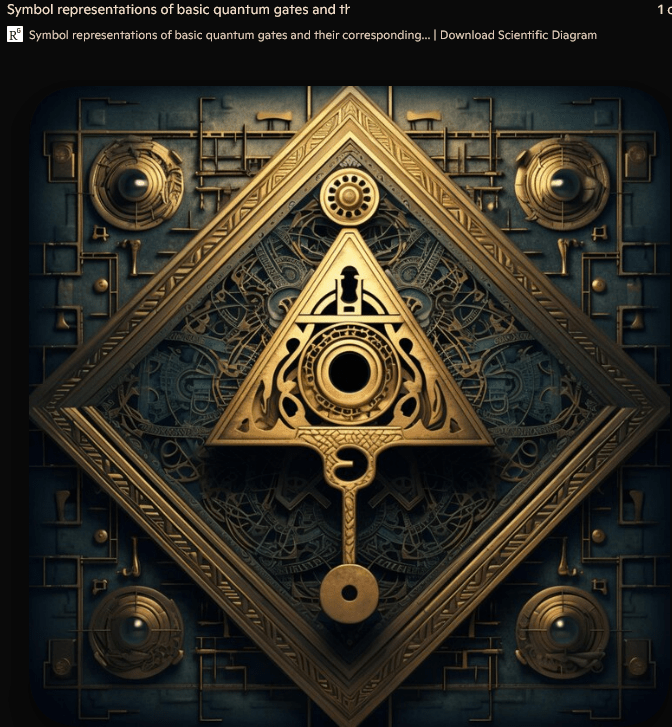
Symbol Representations in Quantum Circuit Diagrams:
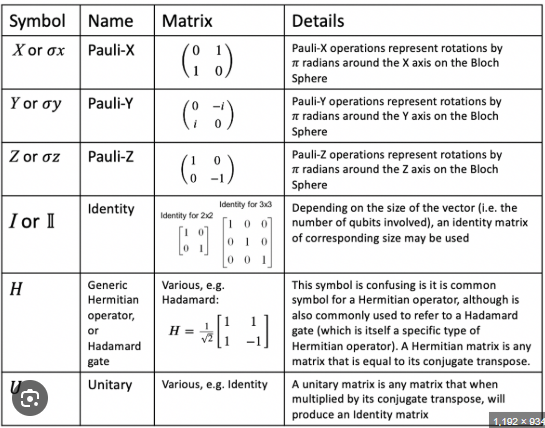
- Pauli X (NOT) Gate: Symbolized by an “X” within a square or a cross inside a circle.
- Pauli Y Gate: Symbolized by a “Y” within a square.
- Pauli Z Gate: Symbolized by a “Z” within a square.
- Hadamard Gate: Symbolized by a square with “H”.
- CNOT (Controlled-NOT) Gate: Symbolized by a filled-in circle (representing the control qubit) connected to a gate symbol (like X) on the target qubit.
- Swap Gate: Symbolized by crossed lines or a specific symbol.
Matrix Representations:
- Pauli X (NOT) Gate: [,].
- Pauli Y Gate: [[0, -i], [i, 0]].
- Pauli Z Gate: [, [0, -1]].
- Hadamard Gate: 1/sqrt(2) * [, [1, -1]].
- CNOT Gate: [,,,].
- Swap Gate: [,,,].
Key Concepts:
- Qubits:.Opens in new tabThe fundamental units of quantum information, similar to bits in classical computing.
Link: https://medium.com/queen-of-qiskit/0-d3f42c35de7
Quantum supercomputing is a revolutionary technology that combines quantum computing with traditional high-performance computing (HPC). It aims to achieve unprecedented computational power by harnessing the principles of quantum mechanics. In a quantum computer, binary bits are replaced by quantum bits (qubits), allowing for exponentially larger datasets and faster computations. Superconducting quantum computing is a branch of solid-state physics that implements superconducting electronic circuits using superconducting qubits. – Google Gemini, AI
Discover more from Omicron Iota Alpha
Subscribe to get the latest posts sent to your email.

